There is a question that lands in the FreeSoul Adventures inbox more than almost any other when it comes to the Kuari Pass Trek: “When should I go?”
It sounds simple. It is not.
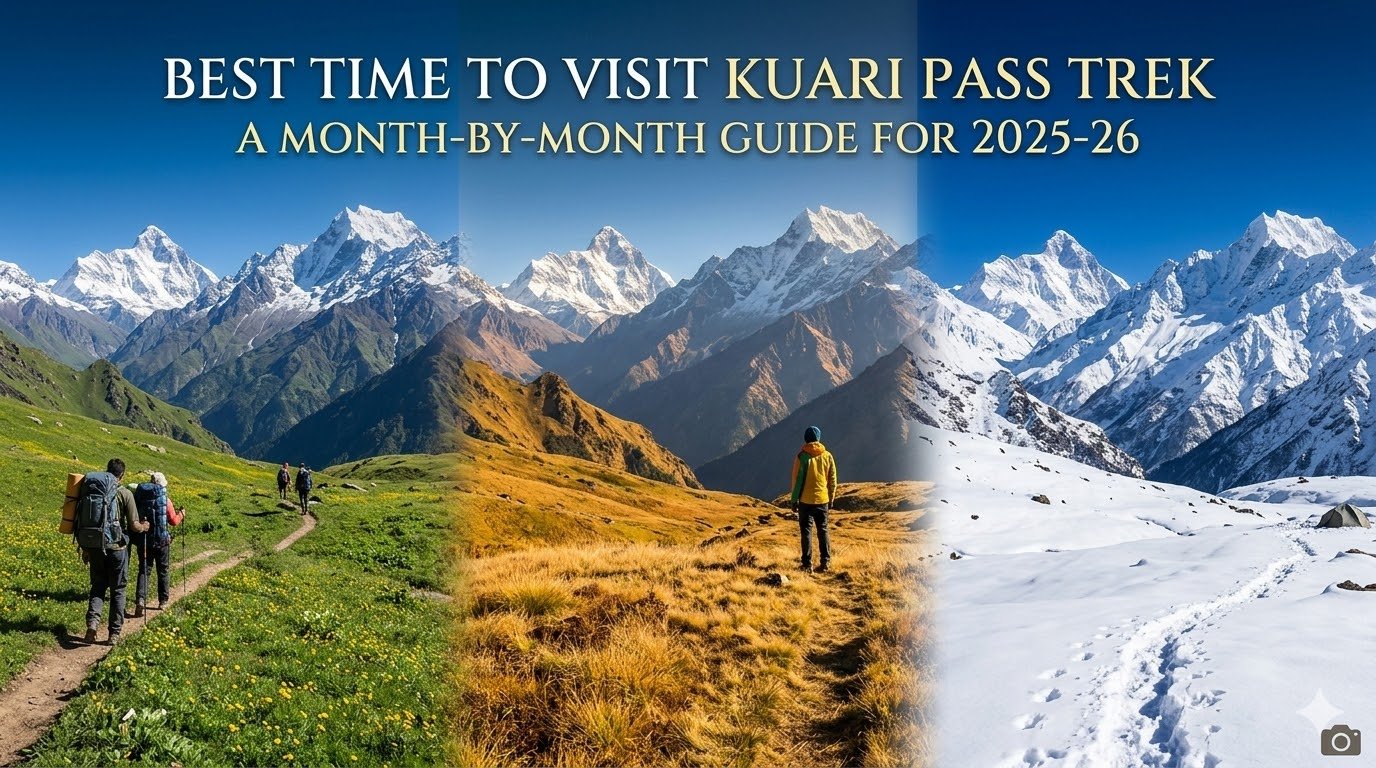
The Kuari Pass Trek is one of those rare Himalayan routes that offers a genuinely distinct experience in every season it is accessible. The October trekker and the April trekker walk the same trail, sleep at the same campsite, and stand at the same pass – but they experience two completely different treks. Different colours, different temperatures, different skies, different challenges, and different rewards.
The right answer to “when should I go” depends entirely on what kind of experience you are looking for – and understanding that difference is what this guide is built to deliver.
At FreeSoul Adventures, we have guided trekkers to the Kuari Pass in every accessible season – from the rhododendron blaze of April to the crystal-clear skies of October. We know exactly what each month feels like on the trail, at Khullara camp, and at the summit. And in this guide, we are sharing everything we know – month by month, season by season – so you can pick the window that is perfect for you.
Overview: Kuari Pass Trek Season Calendar
| Month | Season | Trail Status | Temperature (Day) | Temperature (Night at Khullara) | Recommended? |
|---|---|---|---|---|---|
| January | Winter | Closed (heavy snow) | -5 to 0°C | -15 to -20°C | No |
| February | Winter | Closed (heavy snow) | -3 to 2°C | -12 to -18°C | No |
| March | Late Winter | Partially open | 5 to 12°C | -8 to -12°C | Experts only |
| April | Spring | Open | 10 to 18°C | -2 to -6°C | Yes – excellent |
| May | Spring | Open | 15 to 22°C | 0 to -3°C | Yes – best for beginners |
| June | Pre-Monsoon | Open (early June only) | 18 to 25°C | 2 to 5°C | Partial – early June only |
| July | Monsoon | Closed | 20 to 28°C | 8 to 12°C | No |
| August | Monsoon | Closed | 20 to 28°C | 8 to 12°C | No |
| September | Monsoon/Post-Monsoon | Closed | 18 to 25°C | 5 to 10°C | No |
| October | Autumn | Open | 12 to 20°C | -5 to -10°C | Yes – best overall |
| November | Autumn/Early Winter | Open (early-mid Nov) | 5 to 12°C | -8 to -14°C | Yes – for experienced trekkers |
| December | Winter | Closed | -2 to 5°C | -12 to -18°C | No |
The Two Main Trekking Seasons: A Head-to-Head Comparison
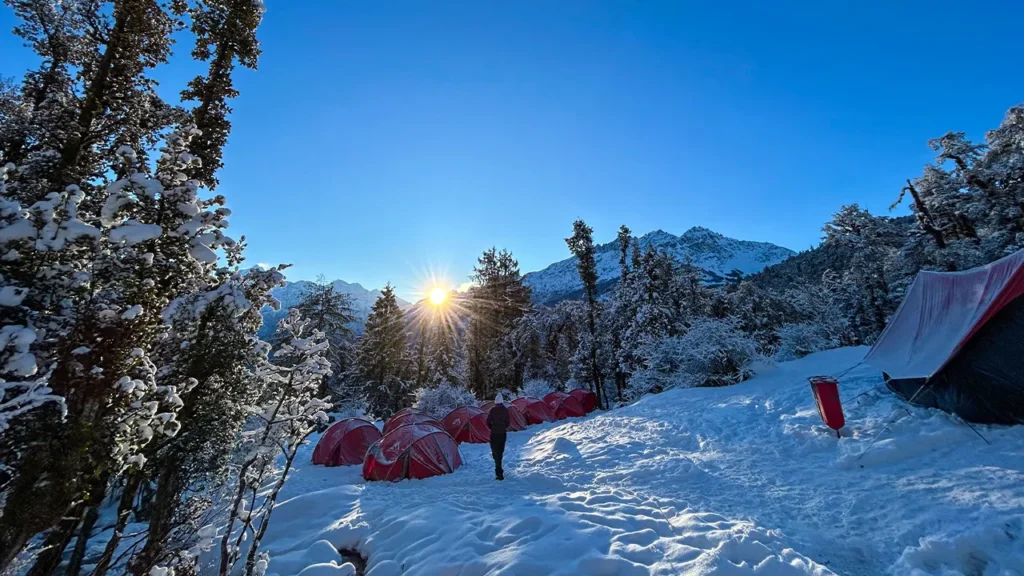
Before going month by month, it helps to understand the two primary windows – spring (April-June) and autumn (October-November) – and how they differ at a fundamental level.
Spring Season: April to Early June
Spring is the season of colour. From mid-March onwards, the rhododendron forests that line the Kuari Pass trail begin to bloom – slowly at first, then in an extraordinary explosion of red, pink, and white that peaks through April and into early May. The lower and middle sections of the trail – the long climb from Karchi through dense forest to Khullara – become corridors of colour so vivid that many trekkers say the forest alone is worth the entire trip.
Snow is still present on the upper sections in April. The Khullara camp area and the approach to Kuari Pass retain consolidated snow through most of April – walkable and beautiful but requiring gaiters and careful footing. By May, the snow has retreated to the highest elevations and the trail is completely clear below 3,400 metres.
Visibility in spring is generally good but slightly softer than autumn – a light atmospheric haze builds through May and June that can reduce long-distance mountain clarity on some days. On clear spring mornings, however, the views are exceptional.
Daytime temperatures are pleasant and warm at lower elevations. Nights at Khullara in April and May are cold – around -2 to -6°C – but manageable with a proper sleeping bag. The overall physical experience of spring trekking is warmer, more colourful, and slightly less demanding in terms of cold management than autumn.
Spring is best for: Trekkers who prioritise visual drama in the forest, beginners who prefer milder cold at camp, and anyone who wants a warmer overall trekking experience.
Autumn Season: October to Mid-November
Autumn is the season of clarity. The monsoon clears the Himalayan atmosphere completely by early October, delivering a quality of air visibility that is almost impossible to describe to someone who has not experienced it. Peaks that are 100 kilometres away appear close enough to touch. Every ridge, every glacier, every rock face on Nanda Devi and the surrounding giants is sharp, detailed, and overwhelming in its presence.
The Kuari Pass panorama – already the finest viewpoint in the Garhwal Himalayas – becomes something extraordinary in October. The 180-degree arc of peaks from Kamet in the north to Trishul in the south is rendered with a clarity and depth that spring’s softer atmosphere rarely matches.
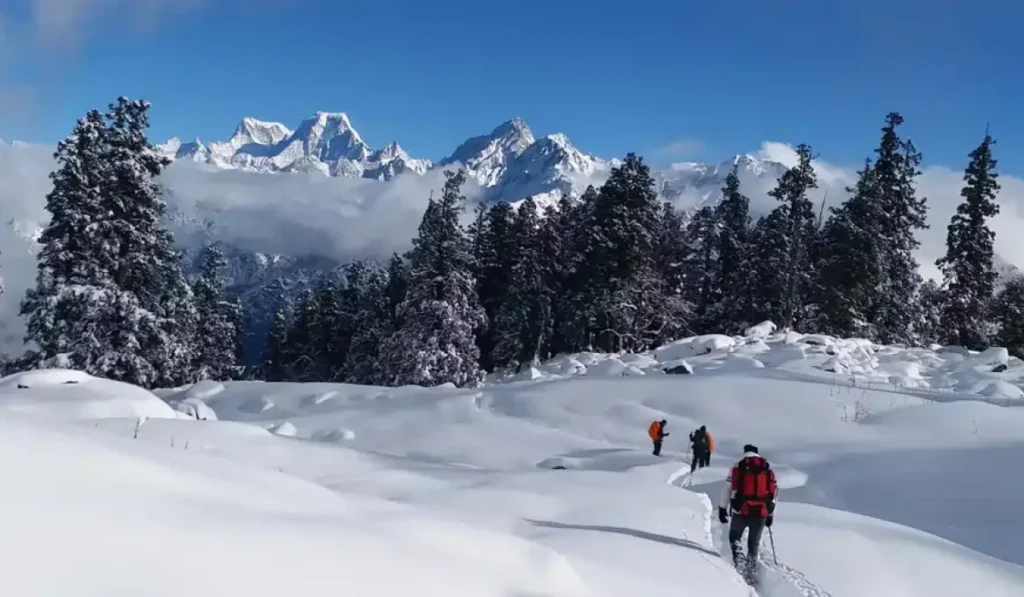
The forests in autumn are golden. The oak and horse chestnut that dominate the middle elevations turn amber and rust in October, creating a warm-toned trail that contrasts beautifully with the white peaks above. Fresh snow from the first winter storms dusts the higher elevations from mid-October onwards, adding the classic Himalayan postcard look to every high-camp morning.
Nights at Khullara in October are genuinely cold – around -5 to -10°C – and require serious sleeping bag and thermal layer investment. November turns significantly colder still.
Autumn is best for: Trekkers who prioritise mountain views and photography, those with proper cold-weather gear, experienced trekkers, and anyone who wants the single finest visual experience the Kuari Pass can offer.
Month-by-Month Guide: What to Expect on the Kuari Pass Trek
January and February: Winter Closure
The Kuari Pass Trek is closed during January and February. Heavy snowfall from December through February buries the upper trail under 2-4 metres of snow, making the route to Khullara and the pass inaccessible without specialist mountaineering equipment. The Rishikesh to Joshimath road can also be affected by landslides and ice during these months.
FreeSoul Adventures does not operate Kuari Pass departures in January and February. If you are dreaming of the Kuari Pass in these months, we recommend planning for October or April and using the winter months for your fitness training.
March: The Shoulder Month
March sits in an interesting position in the Kuari Pass calendar. The winter snowpack is beginning to melt on the lower and middle trail sections, but the upper trail – Khullara and above – is still heavily snow-covered. Temperatures are rising but remain very cold, particularly at night.
Early March treks are possible for highly experienced trekkers with winter gear – crampons, ice axes, and cold-weather camping equipment rated to -15°C or below. But these are specialist expeditions, not standard guided treks.
By late March, the trail below 3,000 metres is largely snow-free and the rhododendrons are beginning to bud. Late March can work for experienced trekkers who want to be among the first to the pass after winter – but conditions are unpredictable and require an operator with current trail reports.
FreeSoul Adventures opens Kuari Pass departures selectively from late March depending on trail conditions each year. Contact our team for the current season’s opening status.
What you will experience in March: Melting snow on lower trail, significant snow on upper trail, cold nights (-8 to -12°C at Khullara), early rhododendron buds beginning to appear, very few other trekkers on the trail.
April: The Rhododendron Peak
April is the month that makes landscape photographers weep with joy. The rhododendron bloom – which builds through late March – reaches its absolute peak in the first three weeks of April along the Kuari Pass trail. The forest between Karchi and Khullara is transformed into something that looks more like a botanical garden than a mountain trail.
Indian rhododendron trees on this trail are not the low garden shrubs most people are familiar with. These are full-sized trees reaching 8-12 metres in height, their entire canopies loaded with clusters of deep red, bright pink, and white flowers. Walking through a fully blooming rhododendron forest on a clear April morning – the sun filtering through the flower canopy, the peaks visible above the ridge – is one of the genuinely magical experiences of Indian Himalayan trekking.
Snow at camp is still present in April. Khullara sits in consolidated snow through most of the month – beautiful for photography, challenging for camp comfort. Gaiters and waterproof boots are essential. The approach to Kuari Pass involves walking on snow for the final section, which requires careful footing and the guidance of an experienced leader like the ones FreeSoul Adventures provides on every departure.
Despite the snow at altitude, daytime temperatures are warm enough on the trail that the overall experience is far from harsh. The cold is concentrated in the evening and early morning – manageable with the right gear.
April is one of FreeSoul Adventures’ most popular departure months and slots fill quickly. Early booking is strongly recommended.
What you will experience in April: Peak rhododendron bloom, snow at Khullara and Kuari Pass, clear mountain visibility, pleasant daytime temperatures, cold nights (-2 to -6°C at Khullara), moderate number of trekkers on trail.
Best for: Photography enthusiasts, trekkers who want the full colour experience, anyone for whom the forest journey is as important as the summit view.
May: The Beginner’s Best Month
May is the month FreeSoul Adventures most frequently recommends to first-time high-altitude trekkers – and for good reason. It combines excellent trail conditions, good visibility, warm daytime temperatures, and the mildest nights of the trekking season at Khullara.
By May, the snow has retreated to above 3,500 metres. The trail from Karchi to Khullara is completely snow-free, well-defined, and dry. The rhododendron bloom has transitioned from its red and pink peak to softer white and lavender varieties at higher elevations. The high meadows (bugyals) near Khullara are green and lush – carpeted in alpine flowers that bloom through May and into June.
Mountain visibility in May is good – not quite the crystalline clarity of October, but on clear mornings the Nanda Devi massif and the surrounding peaks are fully visible and deeply impressive. Afternoon haze can reduce long-distance visibility on some days but clears overnight and in the early morning hours – which is precisely when you want clear skies at the summit.
Nighttime temperatures at Khullara in May are the most manageable of any month the trek operates – hovering around 0 to -3°C. This does not mean a sleeping bag is optional – a bag rated to -10°C remains essential as a safety margin – but the physical experience of May camping is significantly less demanding than October or November.
May is also the month when the Kuari Pass trail is busiest. The combination of good conditions, school and college holiday alignment, and post-exam travel enthusiasm makes May the peak-traffic month. More trekkers on the trail means more noise at campsites and more congestion on popular sections.
What you will experience in May: Snow-free lower trail, possible light snow near Kuari Pass, alpine flowers in meadows, good mountain visibility, warmest nights of the season (0 to -3°C at Khullara), highest trail traffic of the year.
Best for: First-time high-altitude trekkers, families with older children, anyone who wants the most comfortable cold-weather camping conditions, trekkers who are less concerned about solitude.
June: The Closing Window
Early June – the first two weeks specifically – represents a closing window for the Kuari Pass Trek before the monsoon arrives. The trail is in excellent condition, entirely snow-free, and the bugyals around Khullara are at their greenest and most flower-covered. Temperatures are the warmest of any trekking month – genuinely pleasant even at camp.
The challenge with June is twofold. First, atmospheric haze becomes significant by mid-June, reducing mountain visibility considerably on many days. The peaks are still there – but the razor-sharp clarity of October and the good visibility of April and May has softened into a hazy backdrop. Second, the monsoon’s arrival – typically around the third week of June in Uttarakhand – brings the trek season to an abrupt end.
FreeSoul Adventures closes Kuari Pass departures in the second week of June as a standard precaution. Monsoon onset dates vary by a week or two each year, and we monitor weather systems closely to protect our trekkers from being caught in early monsoon conditions on the upper trail.
What you will experience in early June: Entirely snow-free trail, lush green meadows, alpine wildflowers, warm temperatures (2 to 5°C at Khullara nights), reduced mountain visibility due to haze, very few other trekkers.
Best for: Trekkers who prioritise warm temperatures and green landscapes over mountain panoramas, late-season adventurers who missed April and May bookings.
July, August, and September: Monsoon Closure
FreeSoul Adventures does not operate any Kuari Pass Trek departures during July, August, or September. This is absolute – not a guideline but a safety rule.
The southwest monsoon arrives in Uttarakhand in late June and dominates the region through mid-September. During these months, the Kuari Pass trail is dangerous and impractical for multiple reasons.
Heavy and continuous rainfall makes trails slippery and prone to collapse. Landslides are frequent on the Rishikesh to Joshimath approach road – a stretch that sees some of the most severe landslide activity in Uttarakhand during the monsoon. River crossings that are straightforward in other seasons become raging and potentially fatal in monsoon flow. And persistent cloud cover means mountain views – the entire reason to trek to Kuari Pass – are completely absent. You would spend the entire trek in thick cloud, wet, cold, and unable to see even the nearby ridges, let alone Nanda Devi.
If you are planning travel to Uttarakhand during these months, FreeSoul Adventures recommends exploring lower-altitude destinations that are accessible during the monsoon. Contact our team for recommendations.
October: The Crown Jewel Month
If FreeSoul Adventures had to name a single best month for the Kuari Pass Trek – this is it.
October on the Kuari Pass is the month that ruins you for everywhere else. The post-monsoon atmosphere is so clean and clear that the quality of light and visibility is unlike anything you will experience in any other trekking season. The Himalayan panorama from Khullara camp and from Kuari Pass itself takes on a depth and detail that photographs cannot fully capture – the peaks are not just visible, they are present, immediate, and overwhelming.
The forests on the trail are in full autumn colour. The oak and horse chestnut of the middle elevations have turned amber, orange, and deep rust. The contrast of golden forest below, green bugyals at elevation, fresh white snow on the high peaks, and an impossibly blue sky creates a visual composition that makes every step of the trail feel like walking through a painting.
Fresh snowfall from the first winter storms typically dusts the peaks and upper ridges from mid-October onwards – adding the classic Himalayan winter aesthetic to the high-camp experience without yet burying the trail itself in problematic depth.
Temperatures in October require proper gear investment. Khullara nights fall between -5 and -10°C – this is genuine cold that demands a sleeping bag rated to -10°C, quality thermal layers, and a down jacket. But the physical experience of the cold in October is enlivening rather than miserable – dry, clean, still air rather than damp or windy conditions.
The trail in October sees good but not overwhelming trekker numbers. Significantly less crowded than May, but enough fellow trekkers to create a pleasant camaraderie at campsites.
FreeSoul Adventures October departures are our most booked slots of the entire year. If October is your month, book well in advance – these dates sell out early.
What you will experience in October: Crystal-clear mountain visibility, golden autumn forests, fresh snow on high peaks, cold nights (-5 to -10°C at Khullara), moderate trail traffic, finest overall trekking experience of the year.
Best for: Anyone who wants the absolute best Kuari Pass experience – photographers, experienced trekkers, those who have done other Himalayan treks and want the definitive version of this one.
November: For the Cold-Weather Faithful
November divides neatly into two halves with very different characteristics.
Early November (1st-15th): The trail is still accessible and the conditions are a colder, quieter version of October. Visibility remains excellent – arguably even better than October as the air grows colder and denser. Trail traffic drops significantly after the October peak and early November offers something increasingly rare on popular Himalayan treks: genuine solitude. You may walk entire sections of the trail without encountering another group.
The cold in early November is significant – Khullara nights regularly reach -10 to -14°C. A sleeping bag rated to -15°C is recommended, and full cold-weather layering is non-negotiable. The upper trail has more snow than in October, and the approach to Kuari Pass may require microspikes for traction.
Late November (16th onwards): FreeSoul Adventures closes Kuari Pass departures in the second half of November as snowfall becomes unpredictable and increasingly heavy at altitude. The trail to Khullara becomes snow-covered and the pass itself may be completely buried. We prioritise trekker safety above all else, and late November conditions on the Kuari Pass exceed safe operating parameters for our standard guided program.
What you will experience in early November: Exceptional visibility, golden-brown forests, significant snow on upper trail, very cold nights (-10 to -14°C at Khullara), few other trekkers, deep sense of mountain solitude.
Best for: Experienced cold-weather trekkers, those who prioritise solitude and silence over company, trekkers with proper -15°C cold-weather gear.
Quick Reference: Choosing Your Month at a Glance
| Your Priority | Best Month |
|---|---|
| Best overall experience | October |
| Rhododendron blooms | April |
| Easiest conditions for beginners | May |
| Best mountain photography | October |
| Warmest temperatures | May – early June |
| Fewest crowds on trail | Early November |
| Snow on trail experience | April |
| Budget travel (lower package rates) | May – June |
| Autumn colours | October – early November |
| Clearest mountain visibility | October |
What FreeSoul Adventures Recommends: Our Honest Assessment
After guiding hundreds of trekkers to the Kuari Pass across every accessible season, here is what the FreeSoul Adventures team genuinely recommends based on who you are:
If this is your first high-altitude trek: Go in May. The trail conditions, temperature management, and overall physical experience are the most forgiving of any month. You will still get excellent mountain views, beautiful meadows, and the full Kuari Pass experience – just with a gentler introduction to Himalayan camping.
If you want the absolute best the Kuari Pass can offer: Go in October. Full stop. The clarity, the colour, the cold, the views – October is what the Kuari Pass was made for.
If you are a photographer or filmmaker: Go in April for the rhododendron bloom and forest colour. Go in October for mountain panorama clarity and autumn tones. If you can only choose one, choose October.
If you want the trail to yourself: Go in early November. The trekker traffic drops dramatically after the October peak and you will experience the Kuari Pass in a silence and solitude that May and October simply cannot offer.
If you missed the ideal window: Early June is an underrated option – warm, green, flower-filled, and far less crowded than May. Just book in the first two weeks before monsoon risk increases.
Whatever month you choose, the FreeSoul Adventures team will ensure you experience the Kuari Pass at its very best in that season. Our guides know every version of this trail – the spring one, the autumn one, the cold November one – and they bring that seasonal expertise to every single departure.
Frequently Asked Questions About the Best Time for Kuari Pass Trek
Is October or May better for the Kuari Pass Trek? October delivers superior mountain visibility, dramatic autumn colours, fresh snow on the peaks, and the overall finest trekking experience on the Kuari Pass. May is warmer, less cold at night, and better suited to beginners. For the best possible experience, choose October. For the most comfortable first-time experience, choose May.
Can I do the Kuari Pass Trek in December? No. FreeSoul Adventures closes the Kuari Pass Trek program by late November each year. December snowfall buries the upper trail and makes the route to Khullara and the pass inaccessible and dangerous without specialist winter mountaineering equipment.
Is the Kuari Pass Trek open during Diwali? Diwali falls in October or November depending on the year – both within the Kuari Pass trekking season. October Diwali departures are extremely popular with FreeSoul Adventures and often sell out weeks in advance. If you are planning a Diwali trek, book as early as possible.
What is the snow situation on the Kuari Pass in April? In April, significant snow is present at Khullara camp (3,550 m) and on the approach to Kuari Pass (3,640 m). The lower trail from Karchi is largely snow-free. Gaiters, waterproof boots, and careful footing on the final approach to the pass are required. FreeSoul Adventures guides lead trekkers safely through the snowy sections on every April departure.
Does FreeSoul Adventures run treks in all open months? FreeSoul Adventures operates Kuari Pass Trek departures from late March/early April through mid-November, depending on trail and weather conditions each season. We publish departure dates for each season on our website and update them based on current mountain conditions. Contact our team for the latest departure calendar.
Book Your Kuari Pass Trek with FreeSoul Adventures
The Kuari Pass is waiting – and it looks different every single month it is accessible. Whether you want to walk through a tunnel of red rhododendrons in April, stand at the summit in October with the sharpest Himalayan panorama in India spread before you, or experience the deep cold solitude of early November on a trail that feels like yours alone – FreeSoul Adventures will take you there safely, comfortably, and unforgettably.
Check our current departure dates, get a personalised month recommendation from our team, and book your Kuari Pass Trek today. The Himalayas are not going anywhere – but our October departures tend to fill up faster than you might expect.
Book with FreeSoul Adventures. Trek the Kuari Pass. Come back changed.