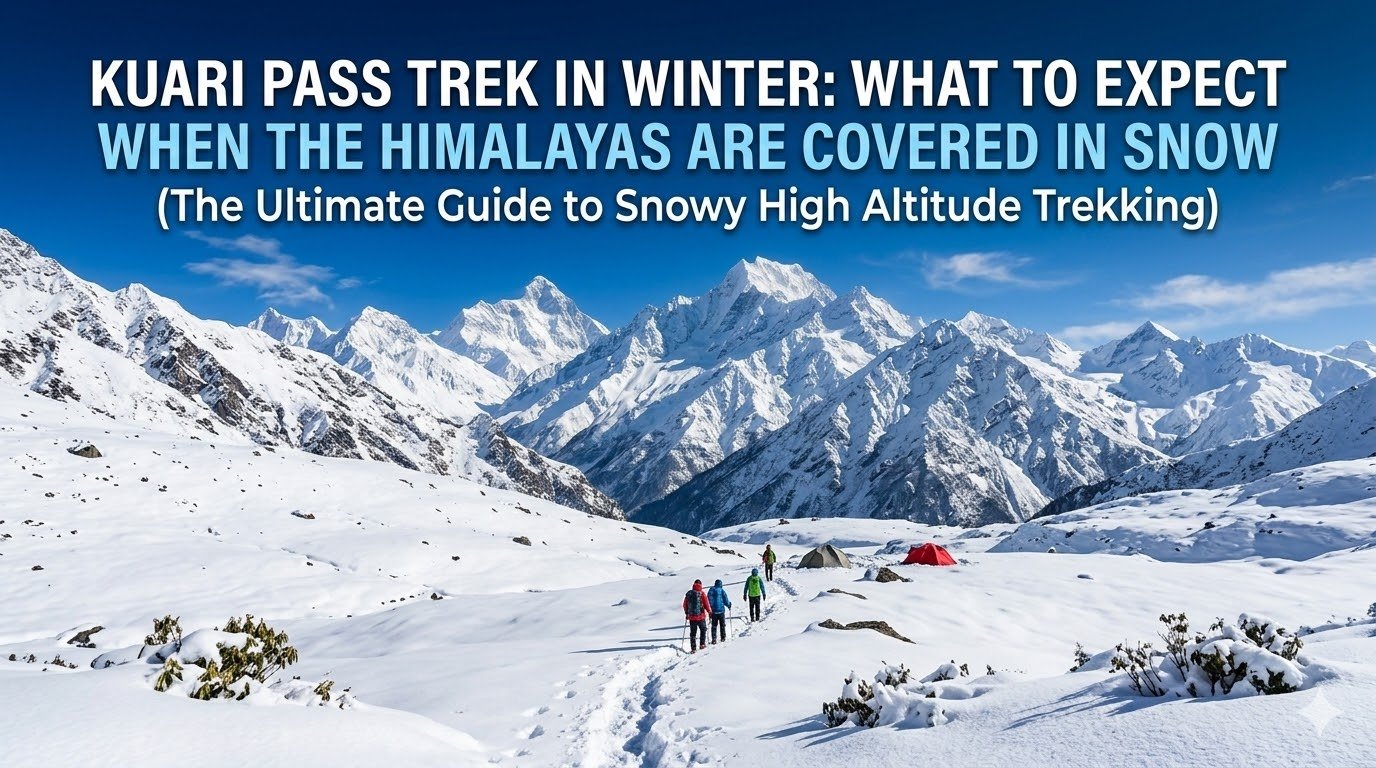
There is a version of the Kuari Pass Trek that most trekkers never see.
Not because it is hidden. Not because it is secret. But because most people look at a winter Himalayan trek and assume it is not for them – too cold, too snowy, too demanding. They book October or May, have a wonderful time, come back home, and never quite shake the feeling that there was another version of that same trail they did not experience.
That version is the winter Kuari Pass.
And for the trekkers who do experience it – the ones who wrap up properly, choose the right window, and step onto a trail blanketed in fresh Himalayan snow – it becomes the trek they talk about for the rest of their lives.
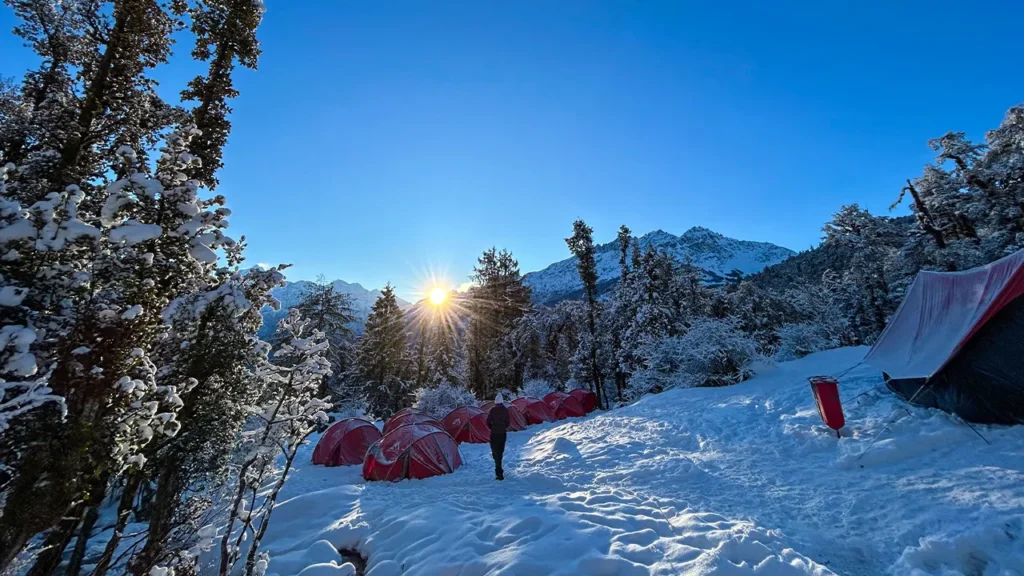
At FreeSoul Adventures, we have guided trekkers through the winter landscape of the Kuari Pass region and watched the same thing happen every single time. The moment a trekker steps out of the tent at Khullara on a clear winter morning – the snow glittering under a sky so blue it looks artificial, Nanda Devi blazing white against it, not another human being visible in any direction – something shifts. The mountain reveals itself in a way it simply does not in any other season. And the trekker standing in that silence understands, immediately and completely, why they came.
This guide is for anyone considering the Kuari Pass Trek in winter. We will tell you exactly what to expect – the snow, the temperatures, the trail, the views, the gear, and the experience – so you can make a fully informed decision and, if you choose to go, be completely prepared for one of the finest winter trekking experiences in Uttarakhand.
What “Winter” Means on the Kuari Pass Trail
Before going deeper, it helps to define what winter actually means in the context of the Kuari Pass Trek – because it is different from what the calendar says.
In the Garhwal Himalayas, the trekking community broadly defines the winter window for the Kuari Pass as mid-November through mid-March. This is the period when significant snowfall transforms the trail character, temperatures at Khullara camp drop below -10°C regularly, and the upper sections of the route require winter-specific gear and expertise.
Within this window, there are two distinct phases that FreeSoul Adventures monitors closely each season:
Early Winter (Mid-November to December): The trail is snow-covered above 2,800 metres but still passable with proper gear. This is the most accessible part of the winter window and the phase during which FreeSoul Adventures runs selective winter departures for fit, properly equipped trekkers. The snow is fresh, the skies are clear, and the trail has not yet accumulated the deep, unpredictable snowpack of peak winter.
Peak Winter (January to mid-March): Heavy, accumulated snowfall buries the upper trail under 2-4 metres of snow. The route to Khullara and the pass requires specialist mountaineering capability – crampons, ice axes, rope management, and cold-weather camping expertise at -15°C and below. FreeSoul Adventures operates peak winter expeditions in this window as specialist programs for experienced mountaineers and cold-weather trekking enthusiasts.
For the purposes of this guide, we will focus primarily on early winter – the most widely accessible and genuinely spectacular phase that most fitness-ready trekkers can aspire to with proper preparation.
Why Winter Makes the Kuari Pass Unforgettable
Let us start with what winter does right – because it does a great deal right.
The Snow Transforms Everything
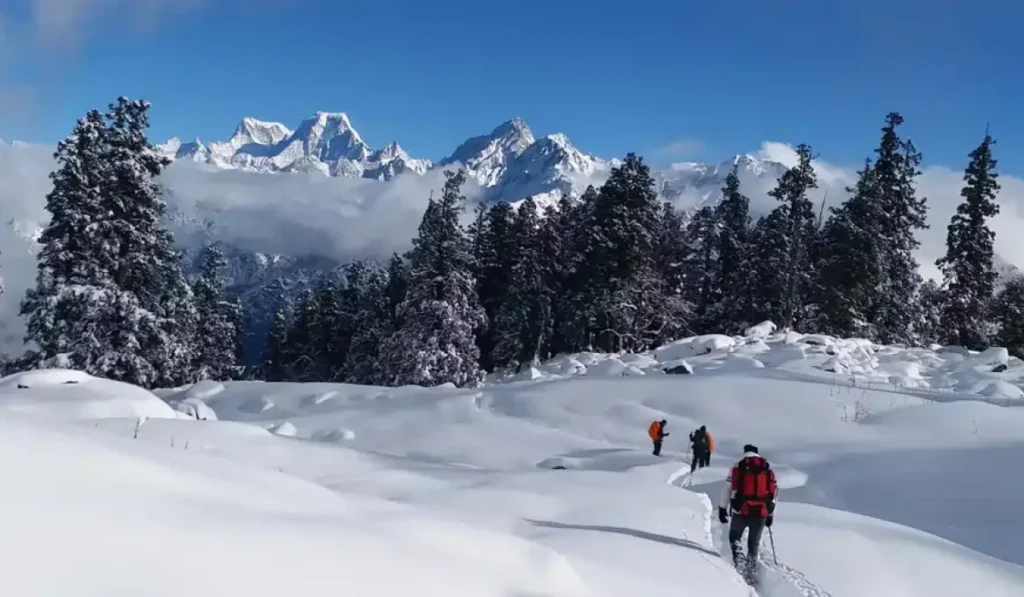
The Kuari Pass trail in winter is a completely different world from what April or October trekkers experience. The forest section between Karchi and Khullara – dense oak and rhododendron in other seasons – becomes a snow-laden wonderland. Branches bent under the weight of fresh snowfall create natural archways over the trail. The forest floor, normally visible through fallen leaves or undergrowth, disappears entirely under an unbroken white carpet. Every sound is muffled. The silence is extraordinary.
Above the treeline, the transformation is even more dramatic. The bugyals around Khullara – open meadows in other seasons – become vast, smooth snowfields broken only by the footprints of wildlife and the occasional wind-sculpted drift. The campsite at Khullara, already one of the finest in Uttarakhand in other seasons, takes on an almost otherworldly quality under winter snow – tents pitched in white silence with the full Himalayan wall rising behind them.
The Mountain Views Reach Peak Clarity
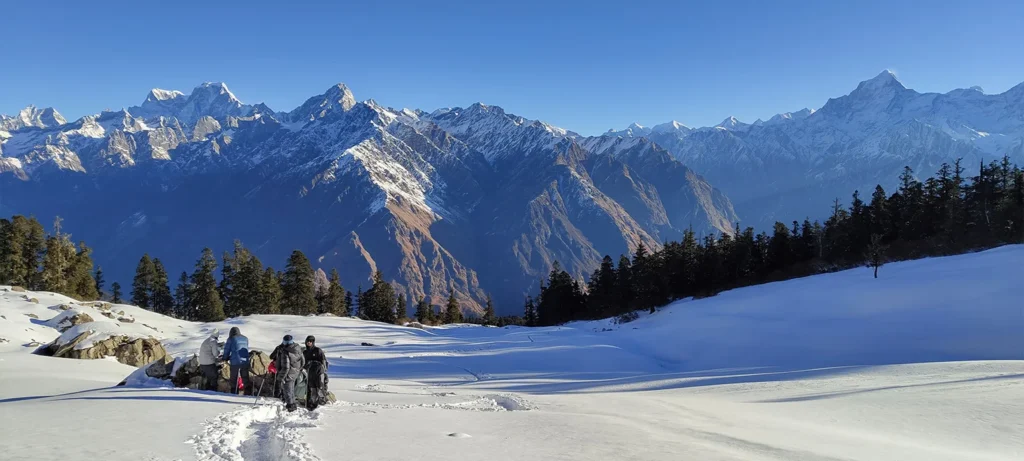
Here is something that surprises first-time winter trekkers: winter air clarity on the Kuari Pass surpasses even October. Cold, dense winter air holds virtually no atmospheric haze. On a clear winter morning at Khullara or on the approach to the pass, the Nanda Devi massif appears so close and so detailed that it seems almost impossible. The glaciers, the rock faces, the individual ridges and couloirs of peaks that are 40-50 kilometres away are rendered with a sharpness that no other season matches.
For photographers, winter light on a snow-covered Himalayan trail is extraordinary. The low winter sun angle creates long shadows across snowfields, the golden hour glow on white peaks lasts longer than in summer, and the contrast of blue sky against brilliant white snow and dark forest produces images of a quality that other seasons simply cannot replicate.
The Solitude Is Complete
The Kuari Pass in winter belongs to almost no one. The October crowds are long gone. The trail is yours. The campsite at Khullara – which can hold twenty to thirty trekking groups simultaneously in October – may have just your FreeSoul Adventures team on a winter departure. There are no voices from neighbouring tents. No queues on popular trail sections. Just the trail, the snow, the peaks, and your team.
For trekkers who have done the Kuari Pass in October and loved it, doing it again in winter is like returning to a favourite place after a snowstorm – familiar in its bones but transformed in its atmosphere. Many FreeSoul Adventures trekkers who have done both describe winter as the more intimate, more personal, more deeply felt experience of the two.
Wildlife Encounters Increase
Winter concentrates Himalayan wildlife in more predictable locations as animals move to lower elevations and follow established routes between food sources. The Kuari Pass trail corridor in early winter offers significantly better wildlife viewing opportunities than the summer and autumn seasons. Himalayan monal pheasant – the brilliantly coloured national bird of Nepal and state bird of Uttarakhand – are frequently spotted in the forest sections. Musk deer tracks cross the snow regularly. On lucky winter mornings, trekkers have spotted Himalayan black bear at the forest edge and occasionally bharal (blue sheep) on the open upper slopes.
FreeSoul Adventures guides know the wildlife patterns of this trail across seasons and will point out tracks, signs, and sighting opportunities that you would miss on your own.
The FreeSoul Adventures Winter Kuari Pass Itinerary
The FreeSoul Adventures winter Kuari Pass Trek follows the same core route as our standard program – Rishikesh to Karchi, Karchi to Khullara, summit day, descent – with modifications to the daily structure that account for shorter daylight hours, snow-covered trail conditions, and the additional time required to manage winter camp operations.
Day 1: Rishikesh to Karchi (Joshimath) – 1,890 m
Early morning departure from Rishikesh in the FreeSoul Adventures vehicle. The drive through the Alaknanda valley in winter takes on a different character – snow on the peaks appears lower and closer than in summer, the river runs clear and cold, and the high ridges visible from the road carry heavy white loads from recent snowfall.
On arrival at Karchi, your winter trek briefing covers everything specific to the season – how to layer effectively, how to manage cold at camp, what the trail conditions look like, and the safety protocols specific to winter trekking. The FreeSoul Adventures team conducts a full gear check to ensure every trekker has the equipment they need before setting out the next morning. A warm dinner and an early sleep set up the demanding Day 2 ahead.
Day 2: Karchi to Khullara – 3,550 m
This is where the winter Kuari Pass experience announces itself. From Karchi, the trail almost immediately begins climbing through snow-covered forest. The footprints of previous trekkers (if any) and wildlife are often the only marks on the trail surface – fresh snowfall can cover tracks overnight, turning a well-worn route into what feels like uncharted wilderness.
The FreeSoul Adventures trail leader sets the pace carefully on Day 2 in winter. Snow-covered trails demand more energy per kilometre than clear trails – feet sink slightly with each step, footing requires more attention, and the body works harder to maintain balance and forward momentum. The daily calorie demand increases in cold temperatures as the body burns more fuel to maintain core temperature. Our kitchen team accounts for this – winter menus are higher in calories and warm meal frequency increases.
The forest section in winter is genuinely beautiful. Rhododendron branches heavy with snow, shafts of winter sunlight breaking through the white canopy, the sound of snow occasionally shifting and falling from branches above – the sensory experience of this section in winter is unlike anything the trail offers in other seasons.
Above the treeline, the ascent to Khullara opens into the snowfields that define the upper trail in winter. The bugyals are buried but the underlying terrain is still readable for an experienced guide. The FreeSoul Adventures leader navigates this section confidently, reading the snow surface and leading the team along the most efficient and safest line to camp.
Arriving at Khullara in winter to a fully set-up FreeSoul Adventures camp – tents positioned to minimise wind exposure, kitchen tent warm and operational, hot ginger tea ready the moment you arrive – is one of the genuine pleasures of a well-organised winter trek. Our team has the camp dialled. You arrive, drink your tea, eat your warm dinner, and sleep under a winter sky that, on clear nights, shows more stars than most people have ever seen at once.
Day 3: Khullara to Kuari Pass (3,640 m) and Back to Khullara
The winter summit morning begins earlier than the standard program – a 5:00 AM departure to maximise daylight on the mountain and ensure the team is back at Khullara well before temperatures drop at the end of the afternoon.
The approach to Kuari Pass in winter is the most technically demanding section of the entire trek. Fresh snow on the steep final approach requires careful footing, and in certain conditions microspikes or crampons are necessary for the last 200-300 metres to the pass. The FreeSoul Adventures team carries these and will brief you on usage before the day begins. Our guides lead this section with direct hands-on support for any trekker who needs it.
And then the pass.
The Kuari Pass in winter is silent in a way that the same spot in October never quite achieves. In October, there are other trekking groups, distant sounds, a general hum of human presence on the mountain. In winter, there is nothing. Just you, your team, the snow, and the Himalayas.
Nanda Devi in winter carries more snow than in any other trekking season. The peak is white from base to summit, its glaciers more visible, its ridges sharper. The winter sun sits lower on the horizon and hits the high faces at an angle that creates shadow and depth on the mountain’s features that the high summer sun never reveals. Experienced trekkers consistently describe the winter view from Kuari Pass as the single most powerful version of what is already the finest panorama in the Garhwal Himalayas.
The return to Khullara follows the morning’s tracks. A warm lunch, an afternoon rest, and a long evening of mountain watching close the most memorable day of the trek.
Day 4: Khullara to Karchi – 1,890 m
The descent through winter snow is physically beautiful and mentally satisfying. The trail that required concentrated effort on the way up flows more easily on the way down – the snow has been broken in, your body knows what it is doing, and the sense of completion that comes with descending from a winter summit gives every step a lightness that the ascent rarely has.
The forest section on descent in late afternoon winter light is extraordinary – the low sun turns the snow in the rhododendron canopy golden and pink, the shadows long and soft. Many trekkers say the descent forest walk on Day 4 is their single favourite memory of the entire winter trek.
Back at Karchi, hot showers, a full dinner, the FreeSoul Adventures completion certificate, and a celebration of what you have just done together.
Day 5: Karchi to Rishikesh
The return drive through the winter Alaknanda valley – the peaks now behind you, the plains gradually returning – with five days of extraordinary winter mountain experience to process, share, and carry home.
What to Wear and Carry: Winter-Specific Gear Guide
Winter gear for the Kuari Pass is meaningfully different from standard trekking season equipment. Getting it right is not optional – it is the foundation of a safe and enjoyable experience.
Clothing – Winter Specific
Base Layer
- Heavyweight merino wool or expedition-weight synthetic thermal top and bottom (2 sets). This is the foundation of your warmth system – invest in quality here.
- No cotton at any point. A cotton layer in winter at altitude is genuinely dangerous.
Mid Layer
- Heavyweight fleece jacket (300-weight minimum)
- Down or synthetic insulated jacket – 700-fill power minimum for winter. This jacket needs to handle -10 to -15°C when stationary at camp and at the summit. Do not compromise here.
Outer Layer
- Hardshell waterproof and windproof jacket – essential for winter wind chill at the pass and in the open bugyals
- Hardshell waterproof over-trousers
Extremities – Critical in Winter
- Heavyweight expedition gloves or mittens – liner glove inside a waterproof outer shell
- Balaclava – full face coverage is essential at the Kuari Pass in winter
- Wool or fleece neck gaiter (2 is better)
- Heavyweight wool or expedition trekking socks (5 pairs)
- Warm camp boots or insulated footwear for evenings in the tent
Footwear
- Waterproof, insulated trekking boots rated to -20°C – standard 3-season trekking boots are insufficient for winter Khullara nights
- Microspikes or crampons – FreeSoul Adventures provides these on winter departures
- Gaiters – full-length, over-the-boot style for deep snow sections
Sleeping System
- Sleeping bag rated to -20°C minimum – not -10°C as in the standard season
- Sleeping bag liner adds critical warmth margin
- Insulated sleeping mat – a standard foam mat is insufficient for winter ground temperatures
Additional Winter Essentials
- Chemical hand warmers (10-15 pairs) – extraordinary value at high altitude
- Insulated water bottle – standard plastic bottles freeze at Khullara in winter
- Thermos flask for keeping water liquid during the summit day
- Extra batteries for headlamp – cold kills battery life rapidly
- Power banks kept in sleeping bag at night to prevent battery death
- Heavier sunscreen (SPF 50+) – UV reflection off snow dramatically increases burn risk
Winter Safety: How FreeSoul Adventures Keeps You Safe
Safety in winter is the highest priority of every FreeSoul Adventures departure. Our winter safety infrastructure goes beyond the standard season program.
Every winter departure includes an emergency oxygen cylinder at Khullara camp, a full wilderness first aid kit stocked for cold-weather emergencies, direct communication contacts with helicopter evacuation services, and at least one guide with specialist winter trekking certification. Our team monitors weather forecasts daily throughout a winter departure and has clear protocols for early descent decisions if conditions deteriorate.
Altitude sickness does not disappear in winter – if anything, the additional physical demand of cold weather and snow travel makes the body more susceptible to the effects of altitude. FreeSoul Adventures winter guides are specifically trained to differentiate cold-related symptoms from AMS symptoms – an important distinction that requires experienced eyes.
The most important safety asset on a winter Kuari Pass Trek is an experienced guide who knows this trail in snow. Our FreeSoul Adventures winter leaders have walked this route dozens of times in winter conditions and carry that knowledge into every decision they make on the mountain.
Who Is the Winter Kuari Pass Trek For?
The FreeSoul Adventures winter Kuari Pass Trek is designed for trekkers who meet the following profile. Be honest with yourself in this assessment – it will directly determine your safety and enjoyment on the mountain.
Physical fitness: You should be able to complete the standard Kuari Pass Trek comfortably before considering the winter version. If you have not previously done a multi-day trek above 3,000 metres, the standard October or May program is your starting point. The winter version demands approximately 30-40% more physical effort than the same route in clear-trail conditions.
Cold tolerance: Genuine comfort in sub-zero temperatures is important. If you have spent nights camping in cold weather and handled it well, you are ahead of the curve. If cold weather causes you significant distress, a winter high-altitude camping program requires honest assessment.
Prior trekking experience: At least one previous multi-day Himalayan trek is strongly recommended before the winter Kuari Pass. Understanding your body’s behaviour at altitude, your gear system’s effectiveness, and your mental approach to demanding days on the mountain is genuinely valuable preparation for a winter departure.
Age: FreeSoul Adventures welcomes trekkers of all ages on standard departures. For winter, we recommend trekkers be between 16 and 60 years of age and in excellent health. Medical clearance is advisable for anyone over 55 or with any cardiovascular or respiratory history.
Frequently Asked Questions
Is the Kuari Pass Trek open in December? FreeSoul Adventures runs selective early winter departures in December for fit, properly equipped trekkers. December conditions are demanding but manageable in the early winter window. Contact our team for current departure availability and trail conditions before booking.
How much colder is the winter trek compared to October? Significantly colder. October nights at Khullara average -5 to -10°C. Early winter nights reach -10 to -15°C and peak winter drops below -15°C. The difference between -7°C and -13°C at 3,550 metres is not incremental – it requires a fundamentally different gear system to manage safely and comfortably.
Can I rent winter gear from FreeSoul Adventures? Yes. FreeSoul Adventures provides rental options for key winter gear items including expedition sleeping bags, down jackets, microspikes, and gaiters. Contact our team well before your departure date to arrange rentals – winter gear stock is limited and advance booking is essential.
Will I definitely see snow on the trail in December? In December, significant snow coverage above 2,800 metres is virtually guaranteed. The lower trail section from Karchi may have light or no snow depending on the year, but from the mid-forest section upwards to Khullara and the pass, snow coverage is consistent and substantial.
Is the Kuari Pass summit accessible in winter? Yes – in the early winter window (mid-November through December) and with proper gear and guide support. FreeSoul Adventures winter departures include the full summit push to Kuari Pass as the program centerpiece. The approach requires microspikes or crampons and confident guide leadership, both of which FreeSoul Adventures provides on every winter departure.
What makes FreeSoul Adventures winter treks different from other operators? Our winter departures are not standard treks with colder temperatures. They are purpose-designed programs with winter-specific gear, winter-trained guides, enhanced safety protocols, adapted menus for cold-weather calorie demands, and a camp setup approach designed for sub-zero nights. The difference between a winter trek run by an experienced cold-weather operator and one run by a standard season operator is significant – and it is most apparent in the moments that matter.
Book Your Winter Kuari Pass Trek with FreeSoul Adventures
The winter Kuari Pass is not the easier version of this trek. It is the more demanding, more rewarding, more deeply memorable version – for the trekkers who are ready for it.
The snow-covered forest on Day 2. The white bugyals of Khullara glittering under a winter dawn. The absolute silence at the pass with every Himalayan giant blazing white against the deepest blue sky you have ever seen. These are not the experiences of a standard Himalayan trekking season. They are the exclusive privilege of the trekkers willing to go when the mountain is at its most powerful.
FreeSoul Adventures will take you there – safely, expertly, and with the full support of a team that has walked this trail in every season and knows exactly what it takes to make a winter Kuari Pass Trek the finest mountain experience of your life.
The Himalayas in winter are waiting. Very few people will ever see them this way.
Book your winter Kuari Pass Trek with FreeSoul Adventures today.